
Arab reactions to war on Iraq
U.S. President George W. Bush's decision to take the law into his own hands and wage war on Iraq brought him closer to Middle Eastern authoritarian rulers accustomed to transgress or even change the law to suit their own purposes.
Publisert:
4. Jul 2003, kl. 14:59
|
Sist oppdatert:
25. Sep 2008, kl. 01:12
Most Arab governments publicly trumpeted their opposition to the Anglo-American war on Iraq which prompted unprecedented anger and anti-American feelings among peoples of all walks of life in the region. But most Arab rulers were far from being saddened by the American scheme to topple Saddam Hussein, not only to please the American administration but also because their Iraqi counterpart was a thorn in their side since he invaded Kuwait in 1990.
On the eve of the eruption of the war, President Mubarak blamed his former Iraqi counterpart for all the misfortunes of the Iraqi people and for preparing the ground for the heavy U.S. military presence in the Gulf and the looming invasion of Iraq.
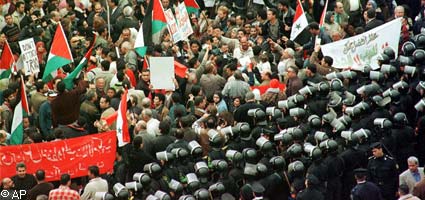
The huge wave of popular protests, the likes of which were not seen in the streets of Cairo since the bread riots of 1977 and the angry reactions against the war in different parts of Egypt forced the government to express solidarity with the Iraqi people and to call for ending the war.
The Egyptian media refrained from abiding by official instructions not to stir people's emotions and not to call civilian victims "martyrs" and to avoid directly attacking President Bush.
The U.S. has been providing substantial economic and military assistance to Egypt since it signed the peace treaty with Israel in 1979. On the eve of the outbreak of the war, Washington promised to provide Egypt, Jordan, and Israel with additional economic assistance. The lion's share, naturally, was promised to Israel.
Twenty-eight Egyptian intellectuals of different political trends including Islamists, leftists, and journalists contributing to the official daily Al-Ahram, publicly expressed their disagreement with President Mubarak concerning who is to blame for the war in Iraq. "This is a new colonial aggression against Iraq and the Arab world," said these intellectuals in their statement. This was the first time that a group of Egyptian intellectuals publicly contradicted Mubarak since he came to power in 1981.
The war suddenly emboldened intellectuals and ordinary people everywhere in the region, including in countries living under emergency law like Egypt or Jordan, or in sophisticated police states like Syria and Tunisia.
Attempts by Arab governments to show solidarity with the Iraqi people and to let the media criticize the U.S. and Britain for claiming that the war would be brief and for causing heavy casualties among civilians had no soothing effect on anti-war protestors. The gap between Arab public opinion and authoritiarian rulers has never been so wide in the region, according to analysts.
Angry and often violent anti-war protestors attempting to march to U.S. embassies in Arab capitals were met with brutal police force. At least one protestor was shot dead by the police in Sanaa, Yemen. Hundreds of men, women, and children, including two legislators were detained in Egypt following massive demonstrations in Cairo on March 20 and 21. Egyptian and international human rights groups said several anti-war protestors alleged that they had been ill-treated or tortured by the police while in custody. They also denounced the brutal attacks and the violation of Egyptians' rights to freedom of assembly and expression.
"I was arrested in Tahrir Square by a State Security officer who pulled me by the hair, punched me in the face, and kicked me in the face with his shoe. The same officer dragged me on the ground for about 20 meters until he threw me inside the police car," said Manal Khaled, an Egyptian anti-war activist. She alleged that later the police officer threatened to rape her, using filty words. Manal also added that he told her that "only rape will make you give up politics."
Tamim Bargouthy, son of Palestinian writer Mourid Bargouthy and of an Egyptian novelist and academic was expelled to Amman because he is a Jordanian passport holder. His mother, Radwa Ashour said Tamim was arrested by four armed men in the middle of the night without warrant, in her home in Cairo. Tamim was born and educated in Egypt.
Arbitrary arrests and attacks on basic rights in the region do not take analysts by surprise. Arab governments have been for decades using brutal methods and arrests to maintain their grip on their respective societies and to stifle every kind of dissent.
Prominent intellectuals and human rights defenders like Moncef Marzouki of Tunisia and Elias Khoury of Lebanon warned against the dangerous impact of U.S. policy in the region after the eruption of the war in Iraq. They both said that U.S. policy, combined with the prevailing tyranny in the region would only strengthen religious extremists. Marzouki said he received the latest U.S. State Department report on human rights for the world, but he threw it away without reading it. "I will read it the day the United States government closes the prison in Guantanamo."
The U.S. support to many authoritarian regimes in the region and its blind support for Israel have fueled feelings of injustice and humiliation, particularly among young people. Radical Islamist groups skillfully exploit these feelings to promote their agenda and gain ground in societies controlled by rulers deeply involved in corruption and more and more skilled at pleasing the U.S. administration.
The launch of the war in Iraq caused the greatest shock in the Arab world since the establishment of the state of Israel and the dispossession of the Palestinians in 1948, according to many analysts. The war has apparently isolated and weakened Arab regimes.
The repression against anti-war protestors, and particularly Egypt's banned Muslim Brotherhood movement, which appeared to be on good terms with the government until the end of the war, shed some light on the determination on the part of the Egyptian governmnent to deal "preemptive strikes" to forces likely to threaten its grip on power.
The future of many authoritarian governments seems to depend not only on internal opposition but also on the U.S., which seems likely to spare its allies like Egypt and Saudi Arabia any pressure, provided they make some cosmetic changes.
Apparently advised by U.S. public relations firms, Saudi Arabia, whose repressive regime produced most of the terrorists involved in the September 11 attacks, said it had a plan to reform its political system and those of the rest of the Arab world.
Such cosmetic changes might serve to reinforce groups advocating the use of violence as the only means for political change and isolate human rights defenders and peace and democracy-loving people in the region.