
Amina Lawal Unites Nigeria
"Amina Lawal has strengthened the democracy and gives hope that the divided and conflict filled Nigeria can be united," says Hauwa Ibrahim, lawyer of the Nigerian single mother who was sentenced to death for adultery.
Publisert:
1. Des 2003, kl. 13:40
|
Sist oppdatert:
25. Sep 2008, kl. 01:13
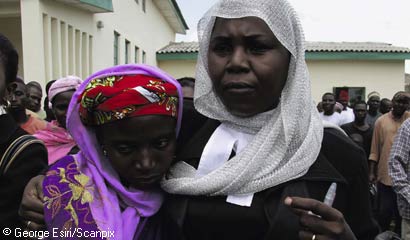
/02a-amina-&-wasila.jpg/$File/02a-amina-&-wasila.jpg) With the riots surrounding the Miss World competition fresh in mind and knowledge of the deep ethnic and religious tensions in Nigeria, Amina Lawal's lawyer surprises with her very optimistic analysis. Wouldn't it be more likely to believe that the acquittal might lead to a broadening of the divisions and increased religious unrest?
With the riots surrounding the Miss World competition fresh in mind and knowledge of the deep ethnic and religious tensions in Nigeria, Amina Lawal's lawyer surprises with her very optimistic analysis. Wouldn't it be more likely to believe that the acquittal might lead to a broadening of the divisions and increased religious unrest?
"This is not about religion. Amina is a deeply religious Muslim, just like myself. The acquittal is neither contrary to Islam nor the Sharia. It is a victory for democracy and for the rule of law for all Nigerians," says Hauwa Ibrahim to AmnestyNytt. She continues: "The sentence establishes a row of important judicial principles, like the right to a defence and the right to be presumed innocent until proven guilty. When Amina was brought to court the judges demanded the opposite – that she was to prove her innocence. She didn't have a lawyer, she wasn't allowed to bring in any witnesses and she didn't understand what happened in the trial because it was conducted in a language she didn't know."
32 year old Amina Lawal became famous around the world when she in March 2002 was sentenced to death by stoning by a local Sharia court in the Katsina state in northern Nigeria. The divorced woman's "crime" was that she had had sex outside of marriage. Her lover had promised to marry her but ran away from his responsibilities when Amina got pregnant. Her daughter, Wasila, born in January 2002, has been used as both evidence and witness against Amina in the trial. The father of the child was not brought to court, because he swore his innocence on the Koran and it was impossible to bring forth four male witnesses to the love-making act. "The practice of the law is discriminatory. It is harder on women than on men" says Hauwa Ibrahim.
Amnesty and the Nigerian women's organisation Baobab have experienced that the way Sharia is practiced in northern Nigeria, contributes to the protection of rapists, while their victims are sentenced to harsh sentences for adultery and false accusations. In addition, the law only applies to Muslims and the harshest sentences are given to people from a deprived background.
Out of consideration for the baby it was decided that Amina was not to be killed until the baby had been weaned, around two years of age. Wasila will be two years old on 8 January 2004, but she will not loose her mother. On the 25 September 2003 the Sharia Appeal Court of Katsina acquitted Amina, and revoked the death sentences given by two subsidiary courts.
Hauwa Ibrahim cooperates with the Nigerian Human Rights organizations Baobab and Wrapa and has done the defence in near 50 Sharia related cases where persons have been sentenced to death, amputation or flogging for sex outside of marriage, use of alcohol or other violations of strict Islamic law.
"Most of them are poor, they can't read or write, they don't know their rights and are very, very vulnerable," she says. Amina has gone to Koran school, but she doesn't know English. She became married already at the age of fourteen and had three children, the oldest is fifteen now. Later she got divorced and married again. She had been divorced from her second husband for nearly a year when Wasila was born.
Hauwa met Amina for the first time in March 2002. Then she had just gotten the single mother Safiya Hussaini acquitted in the Higher Sharia Court in Sokoto state. She had also been sentenced to death for adultery.
"I heard of Amina on the radio and looked her up in the village where she lived. I offered to help her without charge and gave her my business card."
Three months later Amina and Wasal travelled all the way to the capital Abuja where Hauwa Ibrahim lives.
"Amina couldn't read the address on the business card. Instead she went to a big market where she sat down with the baby on her lap." Fortunately someone took pity on the lonely woman who so obviously came from out of town. They took the business card and called Hauwa."From that day on she was living with me. She didn't have any money or any place to go. She and the baby became part of my extended family. Today I see Amina as my sister and Wasila is like a daughter to me."
Hauwa herself is married and has got two sons, one of them only a couple of months older than Wasila. Hauwa also comes from the rural areas of northern Nigeria, she's Hausa just like Amina. But even though they lived together, Hauwa didn't get to know much about how Amina perceived the trial. "It is not in our culture to talk about private things, that's why I didn' ask either" Hauwa explains.
The first time Amina opened up was when Ahmadu Ibrahim came to visit. He is one of Hauwa's clients. "Ahmadu Ibrahim and his girlfriend Fatima Usman are also sentenced to death by stoning, because they had a child without being married. Ahmadu and Amina had a lot to talk about, and for the first time she talked about herself. Other than that she doesn't say much, the small number of journalists who've talked to Amina don't get much from her."
/04a-hauwa.jpg/$File/04a-hauwa.jpg) Hauwa Ibrahim led the group of lawyers who argued for Amina's acquittal when her appeal case came up in the Higher Sharia Court in Katsina the fall of 2002. That was the same judicial authority where Safiya Hussaini was acquitted in the neighbouring state earlier that same year. The court in Sokoto found that the embryo had been conceived before the Sharia law had been adopted, and that she therefore could not be punished.
Hauwa Ibrahim led the group of lawyers who argued for Amina's acquittal when her appeal case came up in the Higher Sharia Court in Katsina the fall of 2002. That was the same judicial authority where Safiya Hussaini was acquitted in the neighbouring state earlier that same year. The court in Sokoto found that the embryo had been conceived before the Sharia law had been adopted, and that she therefore could not be punished.
"In this part of Nigeria it is believed that the embryo can "sleep" in the uterus and that a pregnancy therefore can last for up to five years," explains Hauwa. "That saved Safiya. We used the same argument for Amina, but the argument was rejected because she didn't get a child with her second husband, who additionally was old. We also pointed at a series of violations of court procedures from Sharia and the Koran, but it didn't convince the judges and they upheld the death sentence."
The death sentences for sex outside of marriage in North Nigeria had already caused enormous international attention and condemnation. Amnesty brought up the first case related to Sharia the fall of 2000 when the minor Bariya Ibrahima Magazu was sentenced to 180 lashes for sex outside of marriage and false accusations of rape. The rapists were never punished. Bariya avoided the death penalty because she never had been married. In spite of the sentence being appealed, the punishment was carried out shortly after Bariya had given birth to a child.
Then during fall of 2001 came the death sentence against Safiya Hussaini and the following acquittal in March 2002. Amina Lawal was brought to court almost at the same time.
Amnesty has continually stated that none of these women should have been taken to court. Consenting sex between adults is not a crime and the sentences against Bariya, Safiya and Amina violated Nigeria's own constitution, The African Charter on Human and Peoples' Rights and international human rights conventions.
However, Hauwa Ibrahim never raised the question if it was right to bring Amina to court, and she has never publicly condemned stoning.
Why?
"Winning the case was the most important to us. We could not risk loosing and thereby setting precedence for this kind of death sentences. What we did was to work within the framework of the environment," the lawyer explains.
"Many of the judges of the Sharia court are not familiar with international human rights conventions, they are conservative and very bound by tradition. Then there is no use pointing to international conventions and obligations. We had to start in their reality, what they know and use a language they understand. That's why we pointed to the Koran. In addition we used the Nigerian constitution, to affirm its validity and to establish judicial principles such as the accused not having to prove her innocence."
"In the long run, we are working to reform all the regional laws, so that they will be in line with the constitution and equal and fair for all. But we have to take one step at the time. Amnesty's confrontational line doesn't work in northern Nigeria; it will only add fuel to already very latent conflicts. However, the situation in the south is different. Open debate and differences are more accepted there. Adultery has never been a crime there either. In the north adultery was punishable also before the Sharia penal law was adopted in 1999."
Hauwa has written down and documented all the argumentation that was used through the whole of Amina's court proceedings. It will come in handy in the work with other similar cases. There's no existing account of how many Sharia sentences that involve stoning, amputation or flogging, but Hauwa reckons several hundred.
"We need research on this, someone should travel around to local courts and find out what's happening. I know that Amnesty's researchers have been thinking about this. The cases where I've done defence have come my way by coincidence. For example through the media picking them up and reporting. But there are certainly many cases we know nothing about."
Today everybody knows of Amina. The foreign media coverage has been enormous and more than ten million people have supported Amnesty's actions. In Nigeria, and especially in the north, the case has been given notably less attention, and neither Amina nor Hauwa have been aware of the magnitude of the international attention.
"But of course we have seen all the letters and postcards that has been coming home to me in boxes, several thousand declarations of support from all parts of the world."
Hauwa gives the international campaign parts of the credit for Amina finally being acquitted, but thinks that the most crucial point was that the right to a fair trial was affirmed, and that the judges got increased knowledge through the process. That's a view that Amina shares. With firm faith in Allah and that justice wins in the end, she's all the time believed in an acquittal. However, she sends her thanks to everybody who engaged in her case. She's currently looking forward to going back to her normal life in the village and wish to remarry as soon as possible.
Neither Hauwa Ibrahim nor the supporting body in Wrapa and Baobab believe that Amina will have any problems returning to her village. She's been travelling between Abuja and the village while the trials were going on and has never been harassed by anyone. Her family has supported her all the way, and she lives with her mother and stepfather. After the acquittal the village chief was the first to congratulate and welcome her back, and two men have already shown interst in marrying her.
"Amina needs help to get back to a normal life. However, I believe that the best way for the international community to support Amina and other women in Nigeria is to support the organizations that work for women's education. Then they will be able to stand up for their own rights."
"Through my work for Amina, I've experienced a different world. A world that stood united in respect of human rights and dignity. We need to find the best way to use this experience to the best of all," says Hauwa Ibrahim.
"Recently I met people from Malaysia, Turkey and Sri Lanka. All three told me their insight of the Amina Lawal case from three different perspectives and how they intend to use the arguments and decision of the court in the their countries. They also gave me new perspectives which I can use in my further work in Nigeria."
What impact has Amina had on Nigeria?
"Amina may have a uniting effect in Nigeria. Our country is so divided. With 132 million people we're the most thickly populated country in Africa. We have more than 400 ethnic groups, several religions, different judicial systems and a struggling economy. In a country such as this, we just can't afford being divided. We need a universal law that cannot discriminate against anybody, and we need to discuss a separation between the state and religion.
"If we could unite for Amina and find just one thing to agree upon: That the law must be the same for everyone, independent of belief, where you live and social status. Then - and only then - will all Nigerians be guaranteed the same rights and our democracy will be strengthened."
Translated by Kjetil Bergsås Mikkelsen
AmnestyNytt thanks Hauwa Ibrahim and Wrapa for their contributions to this article
Read more:
- Wrapa continues the struggle for women's rights in Nigeria
- Read Amnesty's documents on Nigeria